
Are Hand Knotted Rugs Worth It? What You're Really Paying For
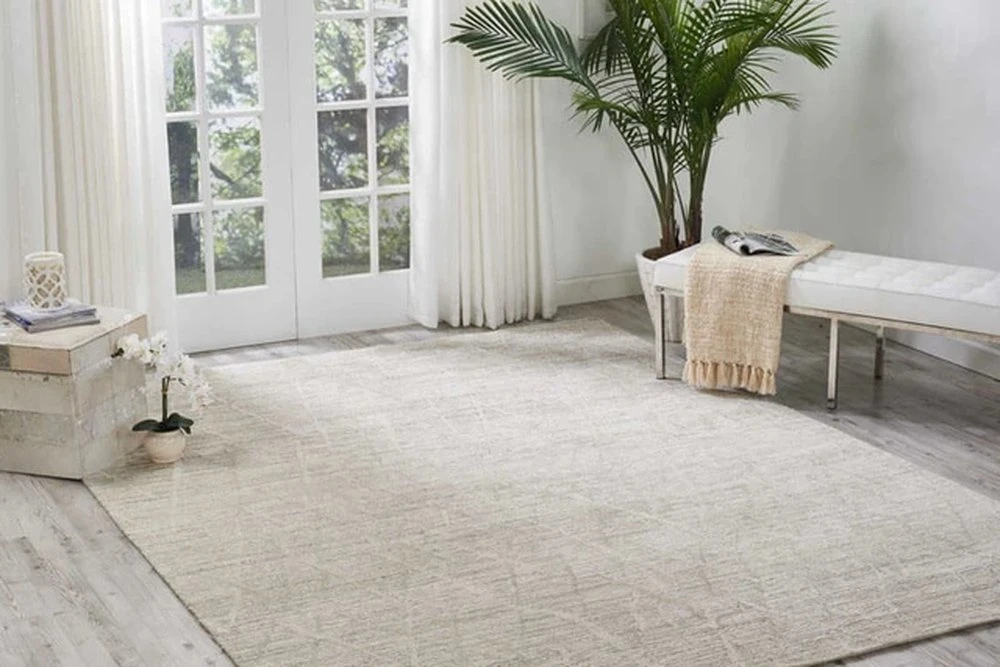
Put two rugs side by side online. Both are wool. Both have a beautiful pattern. Both are 8×10. One costs $700. The other costs $3,500.
Then you spot the difference: the second is described as hand-knotted.
So, are hand knotted rugs genuinely worth several times more, or are you paying for a luxury label?
There is a real construction difference, and it can translate into decades of additional life. But “hand-knotted” alone does not make a rug a smart purchase. Fiber, knotting quality, origin, condition, and how you intend to use the rug matter just as much.
Here’s how to tell what you’re actually paying for and when the premium makes sense.
What Is a Hand Knotted Rug? (And What It Isn't)
A hand knotted rug is made by tying individual pieces of yarn around the warp threads of a loom, knot by knot and row by row. There is no glued-on backing, and the fringe is typically the continuation of the rug's foundation rather than a decorative piece added afterward.
Think of the warp as the rug's skeleton: strong threads run vertically through the entire piece. The weaver ties knots around those threads, while horizontal weft threads help stabilize the structure. Once enough rows have been completed, the pile is trimmed to its intended height.
That construction method has been used for centuries. Museum collections of historic Persian hand-knotted rugs show just how sophisticated the technique can become.
More importantly for today's buyer, it creates a rug with no latex adhesive or secondary backing waiting to deteriorate.
Hand-Knotted vs. Hand-Tufted vs. Hand-Loomed vs. Machine-Made
This is where terminology gets slippery.
“Handmade,” “hand-crafted,” and “made by artisans” don't necessarily mean hand-knotted. A hand-tufted rug involves substantial manual work too, but its construction is completely different: yarn is pushed through a canvas using a tufting gun and then secured with latex before a cloth backing is attached.
Here's the practical difference:
| Construction | How It's Made | Typical 8×10 Production Time | Expected Lifespan | Repairable? | Typical New 8×10 Price |
|---|---|---|---|---|---|
| Hand-knotted | Individual knots tied onto warp threads | 3–12+ months | 50–100+ years | Yes | $1,500–$6,000+ |
| Hand-tufted | Yarn punched through canvas and secured with latex | 1–3 days | 5–15 years | Limited | $300–$1,200 |
| Hand-woven flatweave | Woven by hand without a knotted pile | 1–4 weeks | 15–30 years for wool | Often | $300–$1,500 |
| Machine-made | Produced on a power loom | Minutes to hours | 3–10 years | Generally no |
$150–$800 |
These are broad retail and lifespan estimates, not guarantees. Quality varies considerably within every category.
The easiest buying rule? If construction matters to you, look for the actual term “hand-knotted.” Don't assume “handmade” means the same thing.
Why Are Hand-Knotted Rugs So Expensive?
You aren't paying simply because someone made the rug “by hand.” You're paying for the enormous amount of skilled labor contained in a finished piece.
An 8×10 rug contains 11,520 square inches. Even at a relatively modest 80 knots per square inch, that works out to more than 900,000 individual knots.
Increase the knot density and complexity of the design, and that figure climbs quickly.
But labor is only part of the equation. Price can also reflect:
- the quality and type of wool or silk;
- hand-spinning, carding and dyeing;
- design complexity and knot density;
- shearing, washing, stretching and finishing;
- weaving origin and production costs;
- certification, importing and distribution.
This also explains why rug prices jump significantly as sizes increase. A 9×12 isn't merely 12 inches wider and 24 inches longer than an 8×10. It has 35% more surface area, which can mean hundreds of thousands of additional knots.
Knotting itself isn't proof that the price is justified, though. A poorly made rug doesn't become excellent because it took a long time to make. Materials and workmanship still matter.
How Long Do Hand-Knotted Rugs Last? The Real Value Argument
A well-made hand-knotted wool rug can last 50–100 years or longer with appropriate use and care.
That longevity is arguably the strongest reason to pay more.
There is no latex backing that eventually dries, cracks or separates. Wool fibers are naturally resilient, and the knotted structure can tolerate years of use. Just as importantly, damage doesn't necessarily mean the end of the rug.
Fringe can be restored. Edges can be repaired. Worn or damaged sections can sometimes be rewoven by specialists.
The Victoria and Albert Museum's discussion of the conservation of hand-knotted carpets demonstrates just how repairable these textiles can be when their underlying structure is preserved.
The Cost-Per-Year Calculation Changes the Picture
Suppose you spend $3,000 on a wool rug and use it for 50 years. That's about $60 per year.
Spend $700 on a hand-tufted rug that lasts seven years and you're at $100 per year — before replacing it.
Neither lifespan is guaranteed, of course. A poorly maintained expensive rug can be ruined, while a good less-expensive rug may exceed expectations. But it illustrates why purchase price alone doesn't tell you which rug represents better long-term value.
How to Tell If a Rug Is Hand Knotted
Flip it over. A genuine hand knotted rug should show the design on the back, knot for knot, with no cloth or latex backing. Its fringe should also extend from the rug's foundation rather than being sewn onto the ends.
When you're checking a rug in person, or asking a marketplace seller for additional photos, use this seven-point test:
- Look at the back. You should be able to recognize the front pattern. Small irregularities are normal.
- Check for backing. Cloth covering or visible latex is a strong sign you're looking at a different construction.
- Inspect the fringe. It should emerge from the rug's foundation rather than look stitched onto it.
- Look at the edges. Hand-finished selvedges may have subtle irregularities.
- Brush the pile in opposite directions. A knotted pile generally has a direction, which can create a visible shift in tone or sheen.
- Don't automatically reject imperfections. Slight asymmetry, size variation and abrash (subtle changes in color caused by different dye batches) can be characteristic of handmade production.
- Ask the seller directly. “Is this rug hand-knotted or hand-tufted?” is far more useful than asking whether it's handmade.
Knot Density Explained: Does a Higher Knot Count Mean a Better Rug?
KPSI means knots per square inch. You can estimate it from the back of a rug by counting the knots across one horizontal inch and one vertical inch, then multiplying the numbers.
Very broadly:
| Knot Density | Approximate KPSI | Often Seen In |
|---|---|---|
| Coarse | 25–60 | Moroccan, tribal and some modern rugs |
| Medium | 80–150 | Persian village, Indian, Pakistani and contemporary rugs |
| Fine | 200–500+ | Fine Persian city and silk rugs |
More knots can allow a weaver to create finer curves, intricate borders, and smaller decorative details. Higher knot density can also contribute to durability, although knot count should never be judged in isolation.
The Huntington Library, Art Museum, and Botanical Gardens makes this connection in its description of William Morris's Little Tree carpet. At 25 knots per square inch, the carpet's thickness made the rugs “very durable and worth their higher price tag.”
But higher KPSI doesn't automatically mean a better rug. A substantial 40-KPSI Moroccan wool rug may be a far smarter choice for a busy family room than a delicate 300-KPSI silk piece. Fiber quality, construction, pile, and intended use matter alongside the number of knots.
Best Materials for Hand-Knotted Rugs: Wool, Silk, and What to Avoid
Construction determines how the rug is built. Fiber determines much of how it behaves once it's on your floor.
Hand-Knotted Wool Rugs: The Gold Standard for Everyday Use
For most homes, hand knotted wool rugs offer the strongest balance of longevity, appearance and practicality.
Wool fibers have natural resilience, so they recover well from foot traffic and furniture pressure. Wool also accepts dyes beautifully, hides everyday soil relatively well and is naturally flame-resistant.
You'll encounter New Zealand wool, Tibetan Highland wool, Afghan/Ghazni wool and numerous regional varieties. Don't judge by origin alone. Fiber quality, spinning, knotting and finishing all affect the finished rug.
Some initial shedding can also be normal with wool. Persistent or excessive fiber loss, however, deserves closer inspection.
Wool and Silk Blends
Silk can introduce fine detail and a changing sheen as light hits the pile. Wool-silk rugs can be beautiful choices for bedrooms, formal living areas and lower-traffic spaces. They generally require more careful cleaning than an all-wool rug.
Pure Silk
Fine silk rugs can achieve extremely high knot densities and remarkable detail, but they're closer to collector textiles than everyday workhorses. If you have children racing through the room, a large dog, or regular dinner parties, putting a delicate silk rug under all that activity probably doesn't make sense.
Viscose, Bamboo Silk and “Art Silk”: Read the Fiber Label
This is one area where the construction label can be misleading. A rug can technically be hand-knotted and still be a poor long-term purchase.
Viscose, sometimes marketed in variations such as bamboo silk or art silk, creates a distinctive silk-like sheen and can bring beautiful color variation and visual depth to a rug. It behaves differently from wool, however, particularly when exposed to moisture, stains, and repeated heavy traffic.
That doesn't necessarily make it a lesser choice — it simply makes placement and care more important. If you're considering a rug containing these fibers, think about how heavily the room is used and follow the manufacturer's cleaning recommendations.
Traditional vs. Modern Hand Knotted Rugs: What's Actually Different?
The fundamental construction can be similar whether you're looking at an intricate Persian design or an abstract contemporary rug. What changes are the knot, materials, pile, design vocabulary, density and weaving tradition.
Persian Hand-Knotted Rugs
Persian rugs range from highly detailed city rugs such as Isfahan, Tabriz and Nain to bolder village and tribal styles such as Heriz, Gabbeh, Bakhtiari and Qashqai.
City pieces may reach very high knot densities and incorporate silk, while village rugs often use heavier wool and larger geometric motifs.
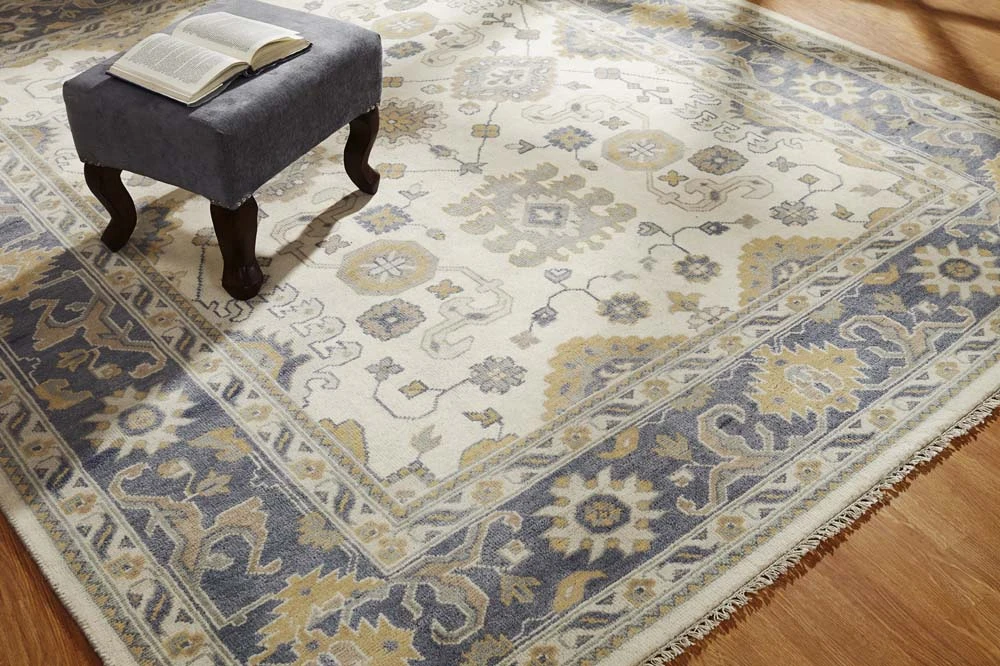
If that detailed, layered look suits your room, this Persian-style collection can offer one example of the rich colors and traditional motifs associated with the style.
Turkish Hand-Knotted Rugs
Turkish rugs traditionally use the symmetrical Ghiordes knot. Oushak designs are particularly recognizable for their larger-scale motifs and softer palettes, while Anatolian tribal rugs tend toward stronger geometry. Fine Hereke rugs occupy another end of the spectrum entirely.
For a contemporary example, explore this Turkish-style rug collection to see how traditional Turkish influences can translate into today's interiors.
If you're trying to build an entire room around this aesthetic rather than choosing a rug in isolation, Payless Rugs' guide to creating a traditional interior offers additional context.
Moroccan Hand-Knotted Rugs
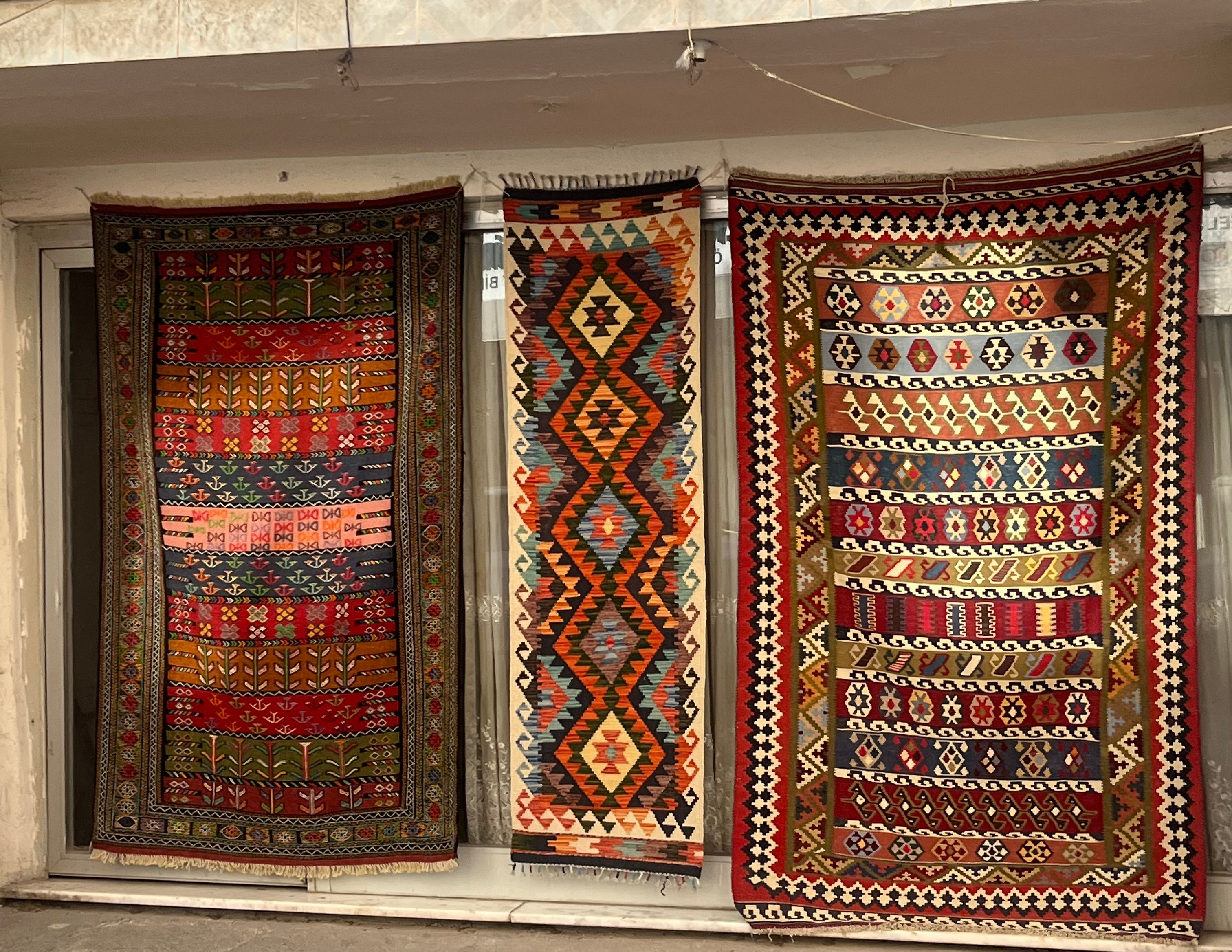
Moroccan styles prove why knot count isn't everything. Beni Ourain rugs are known for thick cream-colored wool and simple dark geometric lines, while Azilal and Boujad pieces can introduce much more expressive patterns and color.
Their knot densities may be comparatively low, but substantial wool creates an entirely different texture. That high pile works particularly well in bedrooms and relaxed living areas, but it's less practical in dining rooms, entries and heavily traveled hallways where dirt can become trapped.
Modern Hand-Knotted Rugs
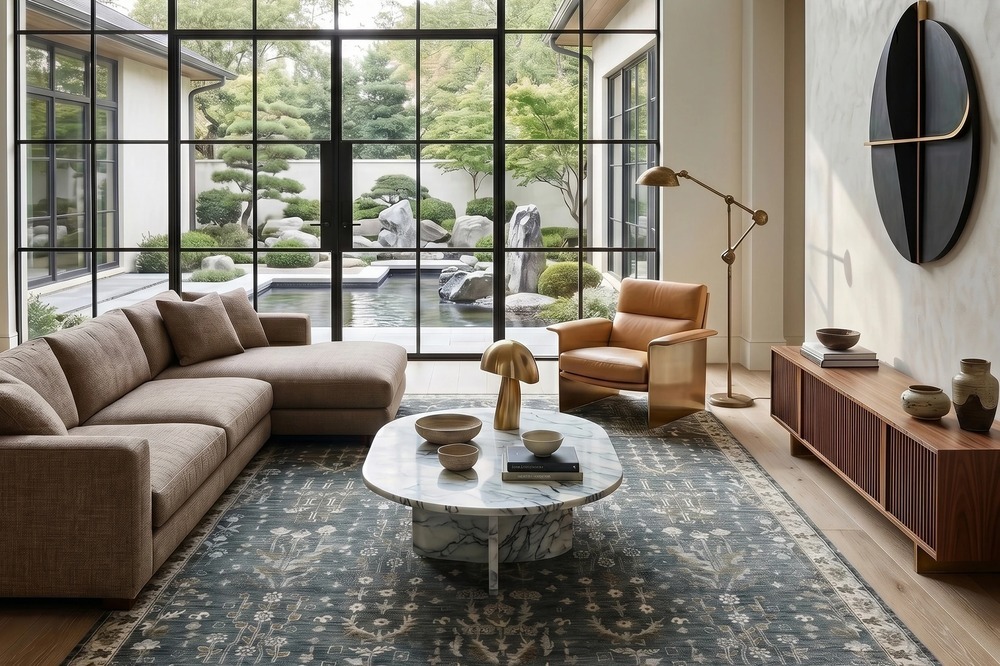
Many modern hand knotted rugs are produced in established weaving centers in Nepal, India and Pakistan. Instead of traditional medallions and borders, you'll find abstract compositions, tonal designs, minimal patterns and intentionally distressed effects.
This can be an attractive middle ground: you get the repairable knotted construction without necessarily paying for the extremely high knot density required by an intricate Persian city design.
Just read the fiber content carefully. Contemporary designs frequently use shiny viscose or “bamboo silk” accents.
Antique vs. New: Which Is the Better Investment?
An antique rug is generally more than 100 years old, while “vintage” covers a much broader and less standardized period below that. A good antique has one obvious advantage: it has already proved it can survive.
It may also have desirable natural dyes, patina, provenance and collector interest. But age alone doesn't create value. Moth damage, dry rot, poor repairs and compromised foundations can turn an apparently attractive antique into an expensive restoration project.
New rugs offer different advantages: predictable condition, broader size availability, contemporary colors and, depending on the maker, clearer information about sourcing and certification.
For many buyers, vintage wool is the smart middle ground — established character and proven durability without the premium commanded by genuinely collectible antiques.
Do Hand-Knotted Rugs Hold Their Value?
Most new rugs should be treated as long-term purchases for your home, not financial investments.
A quality knotted rug generally has substantially better resale potential than a mass-produced or tufted rug, but that doesn't mean you'll eventually sell it for what you paid.
Collectible antique pieces are different. Origin, rarity, condition, natural dyes, provenance, age, size and current design demand can all influence their market value, and exceptional examples may be appreciated.
Buy a new rug because you're prepared to enjoy it for decades. If it retains meaningful resale value later, consider that a benefit rather than the primary reason for purchasing it.
Are Hand Knotted Wool Rugs Good for High Traffic, Kids, and Pets?
For an all-wool hand knotted rug, often yes.
Living rooms and dining rooms are exactly where wool's resilience becomes valuable. Patterned rugs are also forgiving visually because they can disguise small amounts of everyday soil and pet hair better than a perfectly solid pale surface.
There are exceptions.
Silk and viscose aren't sensible choices for hard daily use. A thick Moroccan pile can trap debris in an entryway. Pet urine also needs immediate attention rather than being allowed to penetrate deeply into the foundation.
Use a good rug pad, blot spills instead of rubbing them, and rotate the rug every six to 12 months so sunlight and foot traffic don't repeatedly hit the same areas.
How Much Do Hand Knotted Wool Area Rugs Cost?
Prices vary dramatically, but these broad ranges give you a starting point for new hand knotted wool area rugs:
| Rug Size | Typical Retail Range |
|---|---|
| 5×8 | $800–$3,000 |
| 8×10 | $1,500–$6,000 |
| 9×12 | $2,000–$8,000+ |
Fine Persian rugs, pure silk, unusually high knot counts, rare materials and designer pieces can cost substantially more. Vintage and antique prices vary even more widely because condition and provenance enter the equation.
If you want value rather than prestige, consider modern wool rugs, vintage Persian or Turkish-inspired designs, off-sizes, and reputable sellers with clear return policies.
Where shouldn't you bargain hunt? Unverified marketplace listings and suspiciously inexpensive “silk” rugs are two obvious places.
Are Hand-Knotted Rugs Ethically Made?
The answer depends on the producer and supply chain. “Handmade” is not, by itself, an ethical certification.
The handmade rug industry has faced serious concerns about child labor and working conditions. Buyers who care about sourcing should look for transparent information about where and how a rug was woven.
GoodWeave certification is one recognizable signal, while Label STEP and relevant fair-trade programs can provide additional information depending on the producer and region.
Ask the retailer about the rug's country of origin, manufacturer and available certification rather than assuming a high price guarantees responsible production.
There is also a sustainability argument for longevity. Wool is a natural fiber, hand-knotted construction doesn't depend on the latex backing used in tufted rugs, and a rug that remains usable for generations avoids the replacement cycle associated with shorter-lived floor coverings.
How to Care for a Hand Knotted Rug So It Lasts for Generations
You don't need to treat a good wool rug like a museum object. You do need to avoid a few cleaning mistakes that can do more damage than normal foot traffic.
Vacuum regularly without an aggressive beater bar, and don't repeatedly vacuum directly over the fringe. Rotate the rug 180 degrees every six to 12 months to distribute traffic and light exposure.
For spills, act quickly: blot rather than scrub. Use cold water and, where appropriate, a mild wool-safe cleaner. Avoid harsh spot treatments and oxygen bleach unless a rug-care professional has specifically confirmed they're safe for that piece.
Every three to five years, depending on use, consider professional washing by a specialist experienced with handmade rugs rather than standard wall-to-wall carpet cleaning.
Check occasionally beneath furniture for moth activity as well.
Most importantly, don't assume visible damage means the rug is finished. Fringe, selvedges and even worn areas can often be professionally repaired or rewoven. Repairability is part of what you're paying for in the first place.
Are Hand Knotted Rugs Worth It? The Final Verdict
They're worth the investment when you're buying a quality wool rug for a room you expect to live with for years, you've verified the construction and materials, and you value durability, repairability and the possibility of eventually passing the rug on.
They're harder to justify when you're paying for hand-knotting but getting a fragile fiber, buying around a short-lived decorating trend, or stretching your budget purely because you've been told “handmade” means better.
Worth It If…
You have a long-term home, you're furnishing an important living space, the rug is wool or an appropriate wool-silk blend, and its construction can be verified. It's particularly compelling when you'd rather buy one good rug than repeatedly replace cheaper alternatives.
Probably Not Worth It If…
You're furnishing a temporary space, expect to completely change your décor within a few years, or the price stretches your budget beyond what makes sense for the room.
And if a seller won't clearly tell you how a supposedly premium rug is made? Walk away.
The Smart Middle Ground
You don't have to choose between a $200 machine-made rug and a $10,000 collectible Persian carpet.
A vintage hand-knotted wool rug, a modern lower-KPSI wool piece from an established weaving region, or a well-made wool flatweave can give you much of the longevity you're looking for at a more manageable price.
Frequently Asked Questions About Hand-Knotted Rugs
Are hand-knotted rugs worth it?
They can be. A well-made wool rug may last 50–100 years or more and can be repaired as it ages. The premium makes the most sense when you're buying for long-term use. Hand-knotted construction alone isn't enough, though: poor materials can undermine the value.
How can I tell if a rug is hand-knotted?
Look at the back. You should see the front design reproduced in individual knots without a cloth or latex backing. Check the fringe too: on a genuine knotted rug, it should continue from the foundation threads rather than being sewn onto the finished rug.
How long do hand-knotted rugs last?
A well-constructed wool rug can last 50–100 years or longer with reasonable care. Fiber quality, traffic, cleaning, moisture, sunlight and maintenance all affect lifespan, so the construction method shouldn't be treated as a guarantee.
Is hand-knotted better than hand-tufted?
For longevity and repairability, generally yes. Hand-tufted rugs rely on adhesive and backing and typically have much shorter usable lives. A hand-tufted rug can still be a sensible choice when budget matters more than keeping the rug for several decades.
Are hand-knotted wool rugs good for high-traffic areas?
Good-quality wool versions can be excellent for busy living and dining spaces because wool is resilient and the construction is repairable. Choose pile height and design appropriately for the room, and avoid treating delicate silk or viscose rugs as equivalent.
What is a good knot count?
There isn't one universal number. Around 80–150 KPSI is common in many quality rugs, while fine Persian pieces may reach 200–500+ KPSI. Lower-density tribal and Moroccan rugs can still be extremely durable. Judge KPSI in relation to fiber, design and intended use.
Do hand-knotted rugs shed?
Wool rugs may shed some loose fibers, particularly when new. Moderate initial shedding doesn't automatically indicate poor quality. Excessive or persistent shedding deserves attention, however, particularly if fibers appear to be breaking rather than shedding naturally.
Are Moroccan rugs hand-knotted?
Authentic traditional Moroccan rugs such as Beni Ourain, Azilal and Boujad pieces are commonly hand-knotted, but the market also contains machine-made and hand-tufted Moroccan-style rugs. “Moroccan” describes the design or origin, not a guaranteed construction method.
Are hand-knotted rugs a good investment for resale?
Usually, buy them for use rather than for financial return. New pieces often resell below retail. Certain antique and collectible rugs can retain or appreciate in value when origin, rarity, provenance and condition support demand.
Why do hand-knotted rugs have imperfections?
Minor differences in dimensions, pattern symmetry, edges or color can result from hand-weaving and hand-dyeing. Subtle color variation known as abrash can actually add character. Large distortions or construction defects, however, shouldn't automatically be excused as evidence that a rug is handmade.
A Rug Worth Buying Is a Rug Worth Living With
The case for a hand-knotted rug isn't that it took months to make or that the technique has existed for centuries. Neither fact helps much if the rug doesn't work in your home.
The stronger argument is practical: individually knotted construction, quality wool and the absence of glued backing can produce a rug that survives decades of real use and can be repaired rather than discarded when something eventually goes wrong.
So use a simple rule when you're shopping: quality wool + verified construction + a room you'll enjoy for years = a premium that's often worth paying.
If the material is questionable, the construction can't be verified, or the price is forcing you far beyond a comfortable budget, keep looking. A good rug purchase should make sense after you understand what you're paying for, not before.
Ready to find a rug worth living with for years? Use our Rug Finder to explore Payless Rugs' selection and narrow down the options by the style, size, material, and construction that work best for your home.
Recent Posts
-
Are Hand Knotted Rugs Worth It? What You're Really Paying For
Put two rugs side by side online. Both are wool. Both have a beautiful pattern. Both are 8×10. One c
-

Rug Size Guide: How to Choose the Right Size Rug for Every Room
If there's one mistake that shows up in virtually every home, it's a rug that's too small. A rug flo