
What Size Rug for a Queen Bed? Sizing Chart, Placement & Room Guide
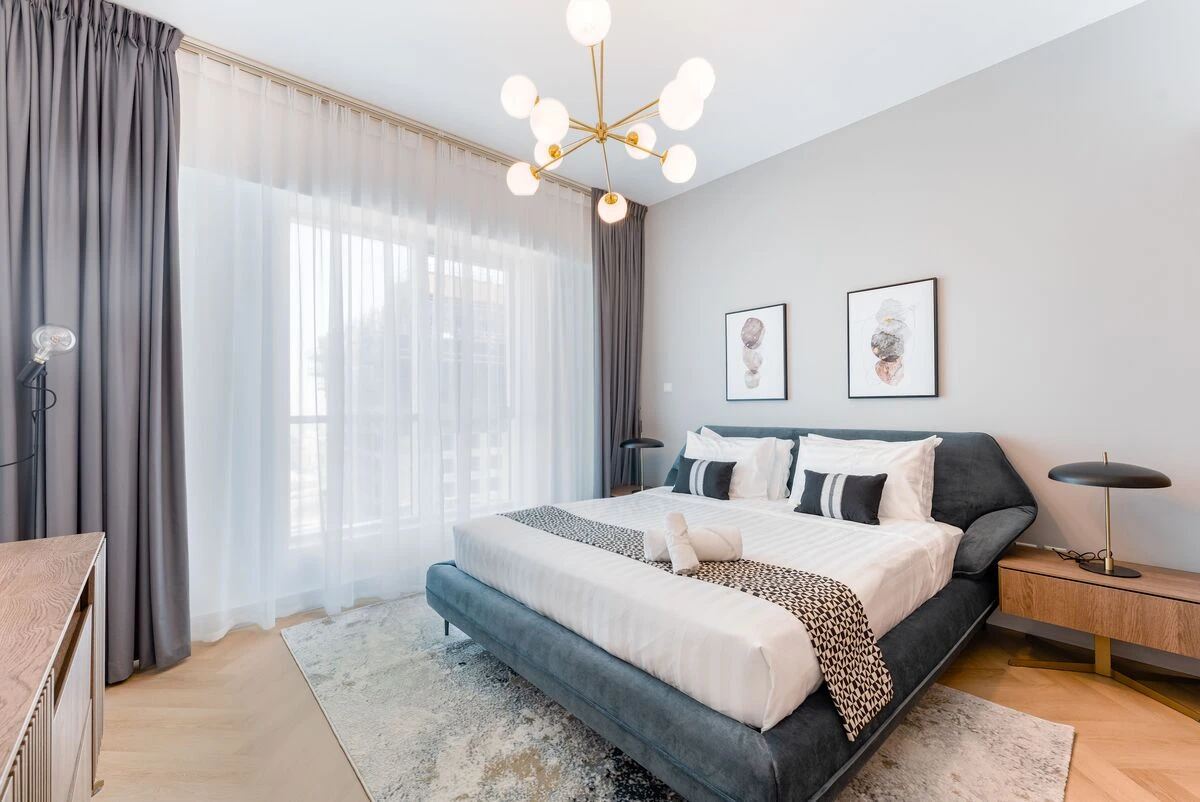
Queen beds are a popular choice for a reason. According to the 2023 mattress industry report, queen mattresses accounted for 41.6% of U.S.-produced adult mattress shipments. But once you've chosen your bed frame and mattress, finding the right rug takes a little more thought. You'll want to consider not just the size of your queen bed, but also the space around it.
If you're wondering what size rug for a queen bed works best, start with the mattress dimensions (60" x 80") and aim for a rug that extends 18"-24" beyond the bed on each side. An 8x10 rug is a great choice for most bedrooms. A 6x9 rug works well in smaller spaces, while a 9x12 creates a more spacious, finished look in larger rooms.
In this guide, we'll cover rug sizes, placement options, room measurements, and alternatives for smaller bedrooms, non-standard queen beds, and carpeted floors to help you find the right fit for your space.
What Size Rug Goes Under a Queen Bed?
An 8x10 rug is the best all-around option for a queen bed. It provides generous side coverage when positioned correctly beneath the lower portion of the bed. Choose a 6x9 for a smaller or standard bedroom, or a 9x12 when you want the rug to extend beneath both nightstands.
Here's a quick breakdown of rug size for under queen bed placement:
- 5x8: A budget-friendly choice for small rooms when placed beneath the lower portion of the bed.
- 6x9: The standard-room sweet spot, with comfortable side exposure and nightstands left on bare flooring.
- 8x10: The most versatile option for a queen bed, depending on placement.
- 9x12: Best for larger bedrooms where you want the bed and nightstands on the rug.
- Two runners: A practical alternative for narrow rooms, apartments, and smaller budgets.
Start With Queen Bed Dimensions: Mattress vs. Frame
When it comes to mattresses, a standard queen size measures 60" x 80" (5' x 6'8"). However, not all queen beds have the same dimensions. An Olympic queen measures 66" x 80", while a California queen measures 60" x 84". A split queen consists of two 30" x 80" mattresses placed side by side.
The bed frame usually takes up more space than the mattress. Depending on the design, it can add 2"-6" on each side, and upholstered, sleigh, and storage frames often require even more room. Measure the full frame footprint rather than the mattress to choose a rug that fits properly.
Your bed’s position also affects rug placement. The headboard typically sits against the wall, so the rug usually begins 6"-12" away from it to clear the headboard legs. Alternatively, you can align the rug with the nightstands, depending on your room layout and the look you want.
The Overhang Rule: How Much Rug Should Show?
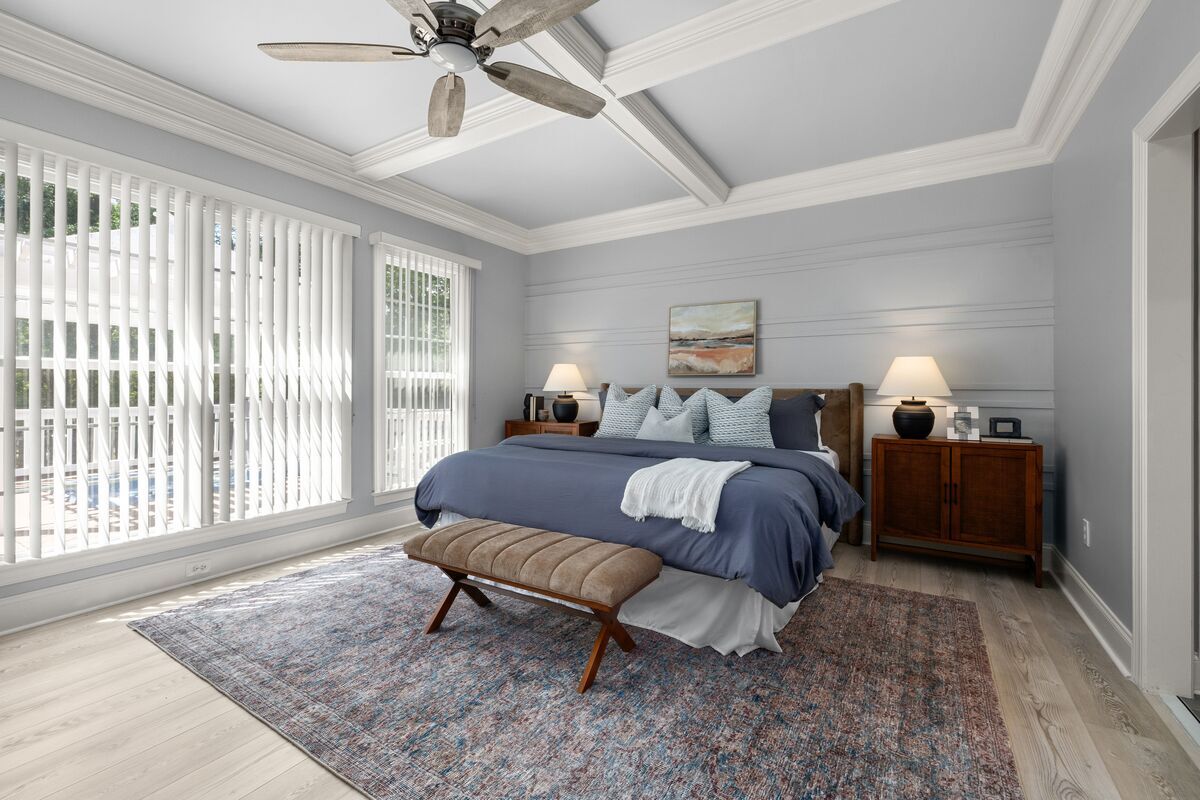
Aim for 18"-24" of rug beyond each side of the bed and 12"-24" beyond the foot. Eighteen inches is a reasonable minimum, while 24" provides a more generous landing area when you get out of bed.
Less than 12" of visible rug can make the arrangement look undersized. In a standard bedroom, more than 36" of extra coverage may use up valuable floor space without adding much comfort.
For most queen beds, position the rug horizontally, with its longer dimension running from side to side. This gives you more coverage where your feet land. Turning the rug vertically can work, but check the visible space at both sides and the foot before deciding.
Rug Size for a Queen Bed: Size-by-Size Breakdown
The best rug size for a queen bed depends on your bedroom dimensions, how much floor coverage you want, and whether the rug should sit under your nightstands. A 6x9 or 8x10 rug works well in many bedrooms, while smaller rugs can suit tighter spaces.
4x6: Too Small for Most Layouts
A 4x6 rug is generally too small to sit beneath a queen bed, leaving only about 6 inches of rug on each side when positioned horizontally. Use it at the foot of the bed, layer it over a larger neutral rug, or place two smaller rugs beside the bed if the room is particularly tight.
5x7 and 5x8: The Small-Bedroom Minimum
A 5x7 or 5x8 rug can work in a small bedroom when placed in front of the nightstands. Depending on the placement, these sizes provide roughly 12-18 inches of visible rug on each side.
A 5x8 often creates a more balanced look beneath a queen bed with two nightstands, while a 5x7 is better suited to tighter layouts, especially if you have only one nightstand.
6x9: The Standard-Room Sweet Spot
A 6x9 rug is big enough for a queen bed in a standard bedroom. Placed horizontally in front of the nightstands, it leaves about 24 inches of rug visible on each side, providing a comfortable landing space when you get out of bed.
The main limitation is that this placement usually leaves the nightstands off the rug. A 6x9 can also work well beneath an Olympic queen in a medium-sized room, depending on the frame dimensions and layout.
7x10: More Room for Your Feet
A 7x10 rug adds side coverage without necessarily extending under the nightstands. Choose it when you want a more generous landing area but don't need a full rug beneath the bedside furniture.
8x10: The Best All-Around Pick
An 8x10 rug is large enough for a queen bed and one of the most versatile bedroom options. Placement determines how much coverage you get. You can position it under both nightstands, leaving roughly 10 inches of rug beyond the foot of the bed, or start it about a quarter of the way down the bed to leave 30 inches or more of rug visible at the foot.
Avoid placing the rug so that only part of each nightstand sits on it. This half-on, half-off arrangement can make the furniture feel uneven. Instead, commit to one layout: place both nightstands fully on the rug or keep them completely off the rug.
9x12: Full Coverage for Larger Rooms
A 9x12 rug suits a spacious bedroom where you want the bed and both nightstands to sit entirely on the rug. With a standard queen bed, it can provide about 42 inches of rug on each side and roughly 22 inches beyond the foot, depending on the frame and exact placement.
This area rug size for queen bed placement works best in rooms around 12x14 feet or larger. It can also cover flooring you don't particularly like. In rooms smaller than about 11x13 feet, however, a 9x12 may leave too little visible floor around the edges.
Larger Than 9x12?
Most queen bedrooms don't need a rug larger than 9x12. However, a California or Olympic queen in a particularly spacious room may benefit from a wider option, such as a 10x12 or 10x14. In these layouts, adding width is often more useful than adding length.
Queen Bed Rug Size Chart
Assumes a standard 60" x 80" mattress, rug positioned horizontally, and placement adjusted to the layout. Exposure is approximate and changes with the frame and rug position.
| Rug Size | Dimensions | Exposure Each Side | Exposure at Foot (under nightstands) | Nightstand Placement | Min. Room Size | Best For / Verdict |
|---|---|---|---|---|---|---|
| 4x6 | 48" x 72" | 6" | None | In front | — | Too small alone; use a pair or at foot |
| 5x7 | 60" x 84" | 12" | None | In front | 10x10 | Small rooms, one or no nightstand |
| 5x8 | 60" x 96" | 18" | None | In front | 10x11 | Small rooms, two nightstands |
| 6x9 | 72" x 108" | 24" | None (or 12"–24" if started lower on bed) | In front | 11x12 | Standard rooms — sweet spot |
| 7x10 | 84" x 120" | 30" | None (or 24"+ lower placement) | In front | 12x12 | Extra side comfort |
| 8x10 | 96" x 120" | 30" | ~10" under nightstands / 30"+ lower placement | Under or in front | 11x13 | Best all-around |
| 9x12 | 108" x 144" | 42" | ~22" | Under | 12x14 | Large rooms, full coverage |
| Two 2'6"x8' runners | 30" x 96" each | 30" each side | None | Beside bed, never under | Any | Small/narrow rooms, budget |
Measurements are planning estimates, not guarantees. Actual exposure depends on the bed frame, rug orientation, and placement.
Area Rug Placement Under a Queen Bed: 5 Layouts
The right area rug placement can make your bedroom feel more balanced, whether you want full coverage beneath the bed or a smaller rug that highlights the space around it.
1. Under the Bed and Both Nightstands
Choose an 8x10 or 9x12 rug when the room can accommodate it. This creates a unified sleeping area and works particularly well with larger bedrooms.
2. In Front of the Nightstands
A 5x8, 6x9, or 7x10 rug can start at the nightstand line. The nightstands remain on the floor, while the rug extends beneath the bed and out toward the foot.
3. Under the Lower Two-Thirds of the Bed
This is a useful compromise when you want more rug visible at the foot. Position the rug below the nightstands and beneath the lower portion of the bed. An 8x10 often works well in this layout.
4. Two Runners Along the Sides
Two runner rugs create soft landing spots without covering the entire floor beneath the bed. They are practical in narrow rooms and can cost less than a large area rug, although the price per square foot varies.
5. A Round Rug
A round rug can look great beneath a queen bed, although it's a less conventional choice. Start it around the bed’s midpoint so the curved edges remain visible at the sides and foot. Check the diameter against your bed and walking space before buying.
Pro tip before you order: Outline the planned rug footprint with painter’s tape. Walk around the bed, open drawers, and check door swings. If the outline feels cramped, the finished arrangement probably will too.
Rug Size for a Bedroom With a Queen Bed: Match the Rug to the Room
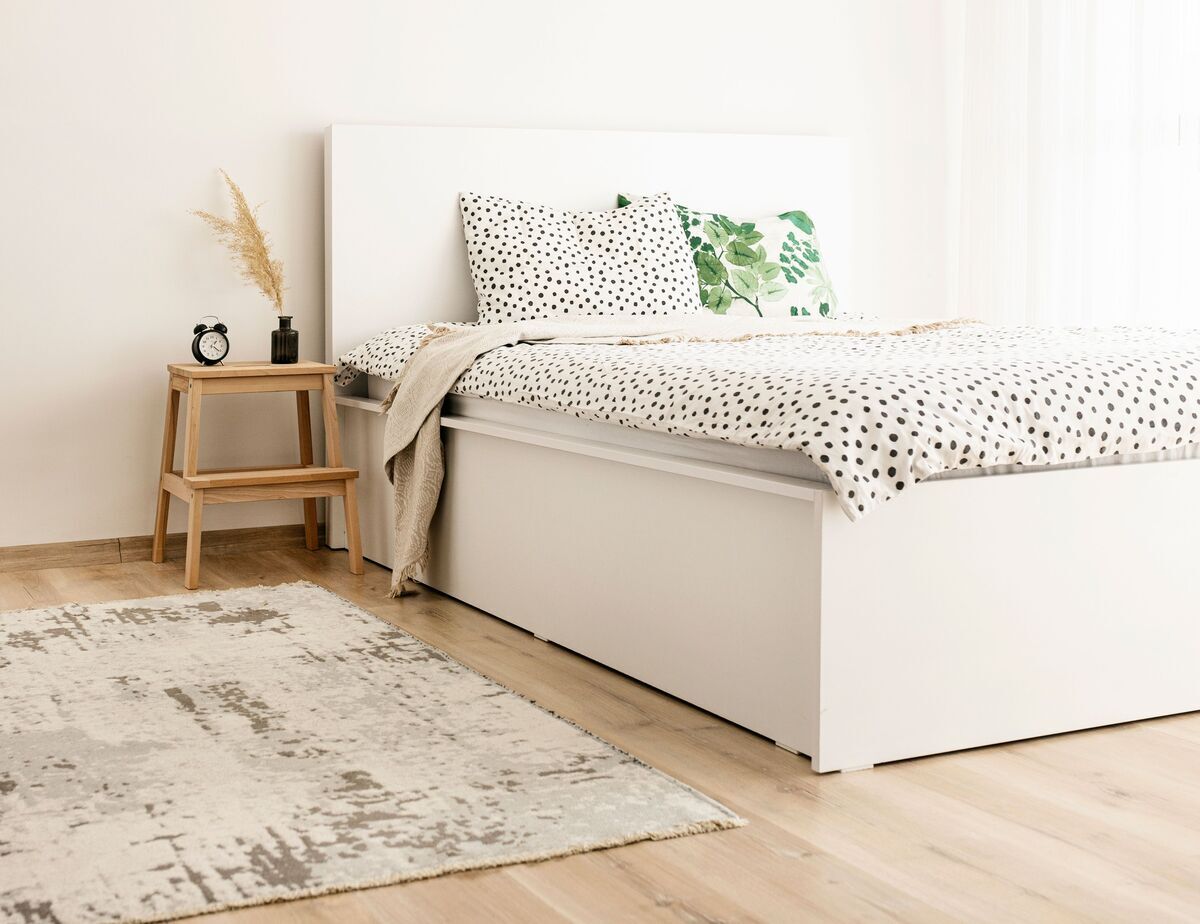
Leave roughly 12"-24" of bare floor between the rug and the walls or nearby furniture where possible. This border helps frame the bed without making the room feel crowded.
Smaller secondary bedrooms around 11x12 feet often work best with a 6x9 or a carefully positioned 8x10 rug. Larger primary bedrooms have more flexibility for a 9x12 rug.
Room Size → Recommended Rug Size
| Room Size | Approx. Sq Ft | Recommended Rug Sizes | Placement | Notes |
|---|---|---|---|---|
| Under 10x10 | <100 | Two runners or 5x7 | Beside bed / in front | Consider one nightstand |
| 10x10 – 10x12 | 100–120 | 5x8 or 6x9 | In front of nightstands | Keep 12"+ border |
| 11x12 – 12x12 | 130–145 | 6x9 or 8x10 (lower placement) | In front / quarter-down | The most common scenario |
| 11x13 – 12x14 | 145–170 | 8x10 | Under nightstands or quarter-down | Avoid half-on nightstands |
| 12x14 – 14x16 | 170–225 | 8x10 or 9x12 | Under nightstands | 9x12 if you want foot exposure |
| 14x16+ | 225+ | 9x12 (or 10x14 for non-standard queens) | Under nightstands | Add a bench at the foot |
Room sizes are approximate starting points. Doorways, closets, dressers, and walking paths may change the best fit.
Small Bedroom? Rug Options That Still Work
A smaller bedroom can still feel cozy with the right rug. Try these options if a larger rug feels too bulky:
- 5x7 rug: Works well if you remove one nightstand.
- Two runners: Place one along each side of the bed for a soft landing spot.
- 6x9 rug: Pull it toward the foot of the bed for more coverage where you need it.
- 4x6 rug: Use it at the foot of the bed as an accent.
- Sheepskin rugs: Add one on each side for extra comfort.
- Low-pile rug: Helps doors open easily and keeps the room from feeling crowded.
Non-Standard Queens: Olympic, California, Split, and Platform Beds
An Olympic queen measures approximately 66" x 80", making it 6" wider than a standard queen. Consider stepping up from a 6x9 to a 7x10 or 8x10 rug if you want more side exposure.
A California queen measures approximately 60" x 84". The extra length makes an 8x10 or 9x12 worth considering, particularly if you want visible rug beyond the foot.
A split queen typically uses two 30" x 80" mattresses or adjustable sections. Since the bases may limit access beneath the bed, runners or a 6x9 rug placed under the lower portion may be easier to manage.
Low platform and floor beds expose more of the rug visually because the frame sits closer to the floor. A 6x9 rug may therefore look more generous than it would under a tall upholstered bed.
For additional guidance, check these queen bed frame dimensions before ordering your rug.
Queen vs. Full vs. King vs. Super Single: How Rug Size Changes
| Bed | Mattress | Typical Rug Sizes |
|---|---|---|
| Super single (42–48" x 75") | Twin-plus | 4x6 (foot/side), 5x7, or one runner |
| Full/double (54" x 75") | — | 5x8, 6x9 |
| Queen (60" x 80") | — | 6x9, 8x10, 9x12 |
| King (76" x 80") | — | 8x10 (lower placement), 9x12, 10x14 |
| California king (72" x 84") | — | 9x12, 10x14 |
As bed width increases, you generally need a wider rug to maintain 18"-24" of side exposure. Always account for frame dimensions and room layout before moving up a size.
Can You Put an Area Rug Over Bedroom Carpet?
Yes, you can place an area rug over wall-to-wall carpet. It defines the bed area, adds color and texture, and can protect the carpet beneath it.
Choose a flatweave or low-pile rug that sits securely without bunching. Use a pad specifically designed for carpet-to-carpet placement; the wrong backing can grip unevenly or damage some carpet finishes. Size the rug according to the same bed and room measurements you would use on a hard floor.
Don't Skip the Rug Pad
A rug pad helps prevent slipping, bunching, and premature wear. Bedroom rugs get stepped on at angles, especially when you swing your feet out of bed, so a pad helps keep the rug in place and adds cushioning.
On hard floors, a felt-and-rubber pad around ¼" thick can provide grip and comfort when compatible with your flooring. On carpet, choose a pad made for carpet-to-carpet use rather than assuming the same product will work on every surface.
Explore rug pads to find an option suited to your floor type and rug.
Common Queen Bed Rug Sizing Mistakes
- Measuring the mattress instead of the frame: Bulky rails and upholstery change the footprint.
- Choosing too little overhang: Less than 18" can leave a narrow, awkward border.
- Leaving a nightstand half on the rug: Commit to a fully on or fully off arrangement.
- Turning the rug without checking the side exposure: More coverage at the foot may mean less where you need it beside the bed.
- Buying a 9x12 for a cramped room: A large rug can leave too little visible floor.
- Ignoring door clearance: High pile may interfere with doors or drawers.
- Skipping the pad: A rug that shifts or curls is less comfortable and less secure.
- Forgetting the bench: If you want all four bench legs on the rug, account for the extra length.
Choose the Right Rug Size With Confidence
Measure the bed frame, check your room dimensions, and aim for 18"-24" of rug beyond each side wherever the layout allows. A 6x9 is a smart choice for many standard bedrooms when placed in front of the nightstands. An 8x10 is the versatile all-rounder, while a 9x12 suits larger rooms where you want the nightstands on the rug.
Use painter's tape to test the footprint before ordering, then add a suitable rug pad for stability. Once the measurements work, explore home decor to help bring the rest of your bedroom together.
The right rug isn't necessarily the biggest one. It's the one that gives your feet a comfortable landing, frames your bed, and leaves enough room to move.
Recent Posts
-
What Size Rug for a Queen Bed? Sizing Chart, Placement & Room Guide
Queen beds are a popular choice for a reason. According to the 2023 mattress industry report, queen
-
Best Rug Pads for Hardwood Floors: How to Choose One That Won’t Damage Your Finish
Choosing the right rug pad for hardwood floors is about more than preventing slips. A quality pad al